
Just like the glacier that was explored The Eight Mountains, the film holds a lifetime of memories and mythologizes every moment as it happens. Written and directed by the husband and wife duo of Felix van Groeningen (Beautiful boy) and Charlotte Vandermeersch, there is a palpable feeling of love in this project that started after a difficult period of their relationship. With the first draft of the screenplay set to be completed in Spring 2020, it’s no surprise they found themselves drawn to such an expansive and nature-based story after being locked up at home.
Based on the beautifully and concisely written novel of the same name by Paolo Cognetti, The Eight Mountains (who won the Jury Prize at Cannes) follows the life of Pietro Guasti, played mainly by Luca Marinelli, from the age of 11 through the following decades. We first meet Pietro when his parents – Francesca and Giovanni, played by Elena Liett and Filippo Timi respectively – take him to a small mountain village for the summer. Here he meets Bruno Guglielmina, whose adult self is played by Alessandro Borghi, and the trajectory of his life changes irrevocably.
A friendship forged in nature
Being the only two children in Grana, the village where Bruno lives and Pietro visits, the pair’s bond may seem inevitable, but their longevity goes beyond just being a friend of convenience. Describing the isolation he experiences in the town, Bruno tells Pietro, ‘They built a road to attract more people to Grana, do you know what happened instead? They have all gone.”
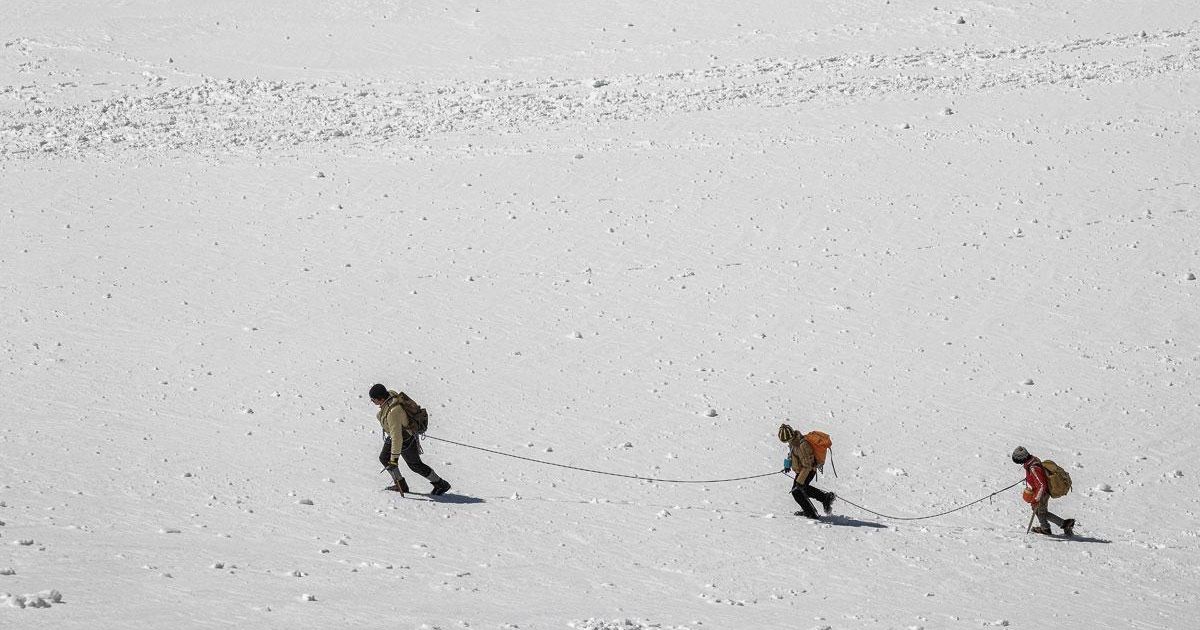
So, with the arrival of another boy his age, how could he not seek friendship? What cements their bond is when Giovanni takes them on beautiful hikes to the surrounding peaks, and especially a glacier. During the glacier hike, the three reach a canyon that Giovanni and Bruno can cross, but Pietro cannot.
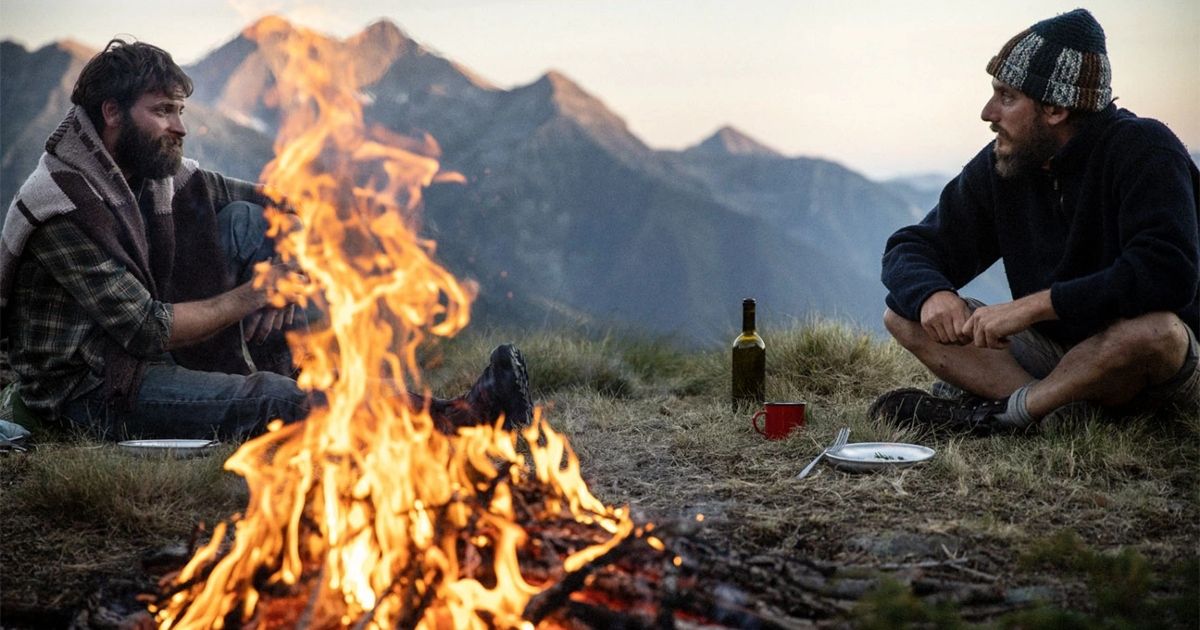
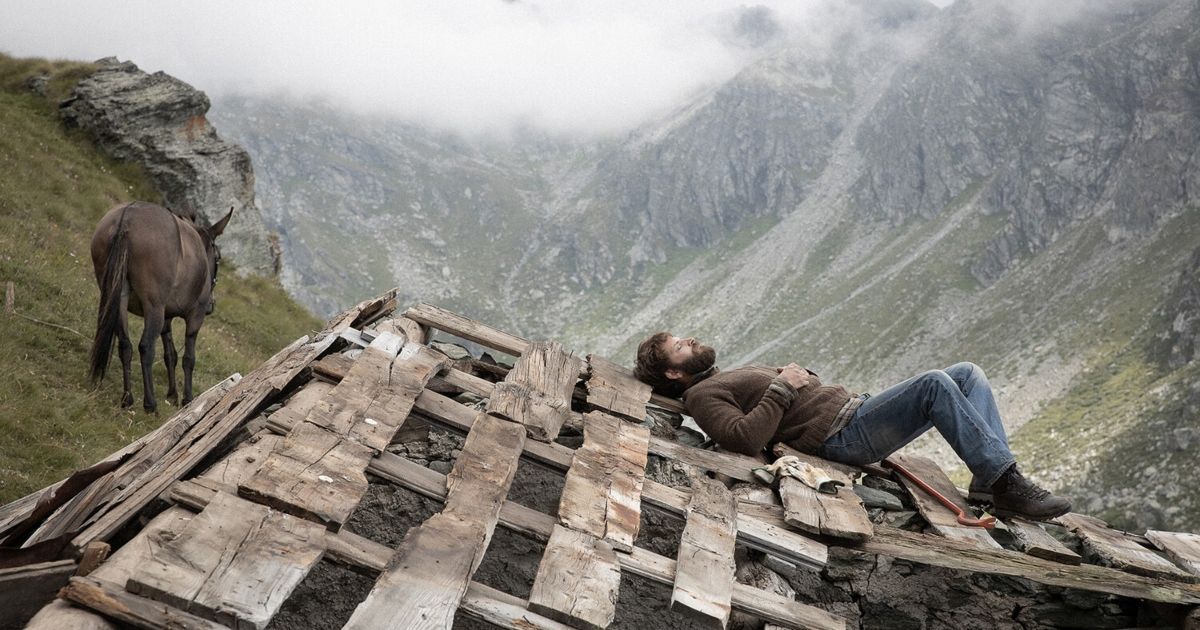
As time passes, the rift between Pietro and his father widens, while Bruno and Giovanni grow closer. After a 15-year break between Pietro and Bruno in which they have no contact, an unexpected event brings them back together. Now, as adults, they are building a mountain cabin together where they will continue to meet in the coming summers. The film gently traverses ideas of dreams, masculinity and nature versus society in a series of walks, conversations and projects. The loose structure is appropriate and allows the story to fluctuate from year to year without feeling disjointed.
The battle between urbanism and countryside
The conflict between a picturesque life in the mountains – working with animals and in the fields – and the looming need to return to the city for education, business or socializing is central to The Eight Mountains. Born and raised at a lower altitude, Pietro feels a responsibility to live a more normal life. He bounces from one unfulfilled job to another, waiting for his chance to return to his mountain retreat. Bruno, on the other hand, cannot imagine a life beyond what he knows, which is making cheese and bathing in streams.
While they envy each other for what they think they are missing, the reality is that they are both hampered by their relationship with the mountains. For Pietro, his dreams seem unattainable because of his deep conviction that a life on the mountain is unsustainable. It is only when he is encouraged by Bruno, who represents this ideal, that he can find real purpose in his work. In contrast, Bruno’s restrictive way of life has its own consequences. He discusses how the way to express sadness in his regional dialect was to say ‘it seems long’, and that he hadn’t thought there were other ways to express emotions, ‘poor words, bad thoughts’. But despite this revelation, he remains stoic despite the turbulence.
This push and pull between the two men and their beautiful yet restrictive surroundings is visualized by the film’s 1.33:1 aspect ratio. While we get to see indescribably stunning landscapes, the aspect ratio denies us the sweeping, expansive images audiences have come to expect. Limiting the images in this way creates a strong and intimate sense of place, but at the cost of expansiveness and freedom.
Plus, it helps to position the film in the setting of the 1980s (to begin with), when aspect ratio was more widely used. This detail from cinematographer Ruben Impens (Black mirror, titan) unites the visual style of the movie with its core debate. He does this in a subtle enough way that it doesn’t interfere with the action itself, yet defines how we experience the entire runtime.
The ebb and flow of a meandering structure
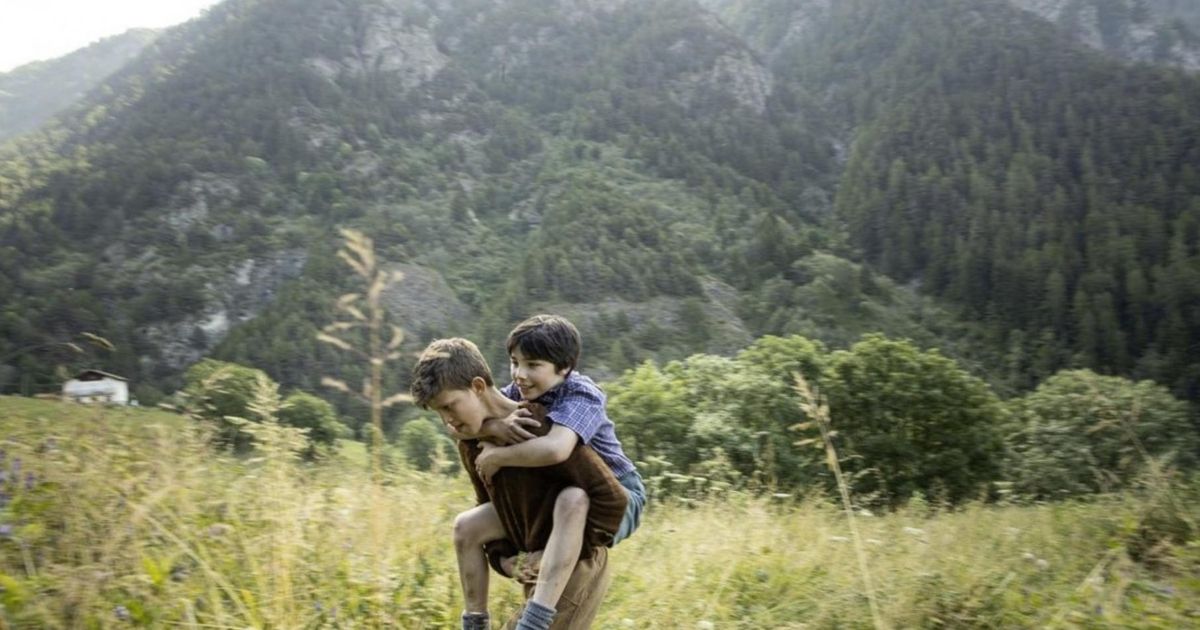
The Eight Mountains has a loose, meandering structure, befitting a film so largely focused on walking and conversation. While this lack of a traditional plot or arc may be off-putting to those accustomed to more rigidly constructed dishes, it’s the most appropriate way to tell this story. In a way, the story feels like a series of vignettes from each season the two friends spend together or apart. This format gives every moment room to breathe and allows scenes to flow into one another with ease.
The free form of these scenes makes extensive use of moments of silence. Instead of fast-talking dialogue that rushes through key moments in order not to lose the audience’s attention, this script takes its time. From our hectic current perspective, this offers a blissful reprieve from our culture of constant contact and notifications. When Pietro and Bruno are walking, we experience the sound of nearby animals, their breathing and the earth under their boots. During their first walk together, Bruno starts talking, but he is quickly interrupted by Pietro who tells him, ‘We can talk later. Now we can’t. We talk when we stop.” It is these silences that promote our immersion in their remote world.
Where The Eight Mountains’ structure is lacking is in the pacing and how it captures the passage of time. The early stages of Pietro and Bruno’s life, as children and adolescents, pass quickly. As a result, the establishment of the complex relationships between Bruno, Pietro and Pietro’s father is somewhat rushed.
An argument could certainly be made that in the grand scheme of life these early years pass quickly and the film reflects the elusiveness of youth. However, when so much of the film hinges on the boys’ relationship with the men in their lives, it could have spent more time exploring that. Especially when you consider that the filmmakers have 147 minutes at their disposal and a final act that stays just a little too long.
Machismo, fatherhood and the mountain
One of the most refreshing aspects of this film is its ability to discuss masculinity and fatherhood in a way that feels natural. It avoids falling into the camp of overly graphic critiques, such as The Banshees of Inisherin, who use violent shock tactics to get their point across. Instead, it simply presents us with a complex dynamic between two men and their fathers. Pietro was ashamed of his father’s lack of social life and dreams, which made him want freedom and escape. Bruno’s father took him away from his home to work when he was only 13, so as soon as he could, he returned to the mountain and never wanted to leave.
Later, there are thoughtful discussions about their fathers’ families and how the different generations have influenced each other. The fact that Pietro and Bruno spend time unpacking these cycles is especially sensible given Italy’s machismo culture. Although patriarchal ideals and misogyny are widespread worldwide, they affect each culture differently. In a voiceover, Pietro says that his mother was “used to live among quiet men” and would therefore bear the burden of communication for the family. Pietro and Bruno go a long way in improving their father’s actions, but an inability to communicate in a completely unguarded way remains.
As reported by Magazine Filmmaker, another actor was originally cast as Giovanni, but dropped out due to filming circumstances and had to be replaced at the last minute. This worked in the movie’s favor, as Timi did an amazing job with the relatively few scenes he had. He conveys anger, sadness, strength and weakness all at once and lays an incredible foundation for the subsequent observations about masculinity throughout the film. Without his performance as the patriarch, the story would not begin to flow through various discussions of connections to friends, nature, and the self, inevitably returning to tranquility on the mountain, just as Pietro and Giovanni do.
From Wildside, Rufus, Menuetto and Pyramide Productions, in association with Elastic Distribution, The Eight Mountains opens May 5 in Los Angeles courtesy of Vision Distribution, and you can find it showtimes and listings here.